
Explore the Sky Challenge 2026-2027

Our annual Observation Challenge is back!
We're inviting you to discover the wonders of the sky through December and January. There are so many beautiful things to see in the sky when you take the time to look up! With this challenge, you'll have the chance to observe the Moon in various phases and a few planets, as well as learn to identify several stars and constellations.
In this blog, you'll find information on all the observations and the best times to do them.
SPECIAL INVITATION for TEACHERS AND EDUCATORS!
Register for our challenge to receive reminder emails about what's visible each week. You'll also receive additional educational material to learn more about the celestial objects and phenomena.
You can download the Challenge Sheet to note your observations. If you're lucky and manage to fill it, you can print a new sheet or start an observational journal. The weather might not cooperate, but that's part of the challenge!

Click the image above to download the Challenge Sheet (PDF).
This year's Observations
NOTE: These observations are visible throughout southern Canada and at similar latitudes (such as Europe). Some of them could be quite difficult for northern latitudes or impossible at very different latitudes. Contact us if you have any questions.
Click on the arrow of each item to see the image and the description:
1 - Last Quarter Moon 🌗
The Moon shines because it reflects light from the Sun. Depending on its position along its orbit around the Earth, its appearance changes: these are known as its phases. If you go to observe it frequently, you will be able to see each of its phases.
The last quarter moon is visible in the morning. If you go outside with your students before lunch, look up to catch a glimpse of the last quarter moon, or the crescent moon (in the days that follow the last quarter).
The best times to observe it during this year’s Challenge are December 1, December 30, and January 29, 2027. The image below shows the position of the Moon and the Sun in the mid-morning around these dates.

2 - The Summer Triangle: the stars Deneb, Vega, and Altair
In the early evening, you can see the stars Vega, Deneb, and Altair forming a triangle in the western part of the sky. This triangle is called the Summer Triangle, as it appears very high in the sky during the summer months. It remains visible through autumn and into early winter, though only for a short time after sunset in the western sky.
The three stars of the Summer Triangle each belong to a different constellation: Vega to Lyra, Altair to Aquila, and Deneb to Cygnus.

3 - Morning Planets: Venus, Mars and Jupiter
If you get up early, look toward the east to spot the planet Venus. It is strikingly bright these days —impossible to miss! It is by far the brightest point of light in the sky and remains visible even as daylight begins to break.
Once you've spotted Venus, look higher up and to the right to see Mars and Jupiter. While not as bright as Venus, they are still brighter than most stars. These two planets can also be seen in the eastern sky late in the evening. As they rise earlier each night, they will be visible around 8:30 p.m. by the end of January.
If the sky is still dark enough, you can also try to spot the stars Arcturus and Spica. The image below shows the sky approximately one hour before sunrise.

4 - First quarter Moon 🌓
The first quarter moon is always visible from mid-afternoon until early evening. This is a great opportunity to take your students outside for a group activity or to invite them to look up as they leave school.
The best days to observe the first quarter moon this year is December 17 and January 15, 2027. During this phase, the Moon rises around noon and sets just after midnight. You can see it high in the sky in the afternoon, or closer to sunset, when it will be found in the southwest. The image below shows the Moon and the Sun around 2:00 PM.

5 - Saturn and the Moon
This winter, Saturn is easily visible in the southern sky in the early evening. It is the brightest point of light in that direction in the evening, though it can be somewhat difficult to identify since it doesn't stand out as much as the other planets.
The Moon is there to help you on December 17 and 18, as it passes close to Saturn. A similar approach will also occur on January 13 and 14, 2027.

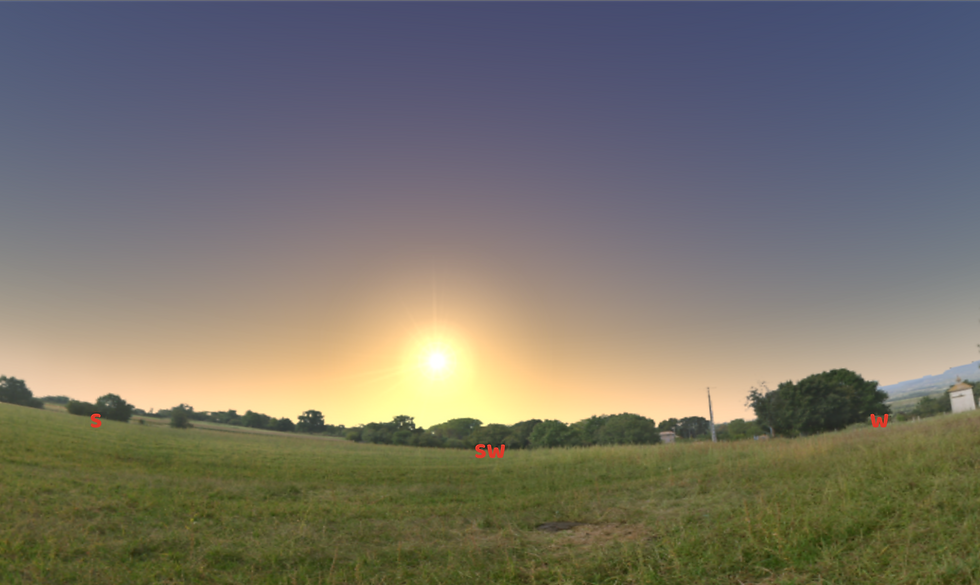
6 - Sunset at solstice
On a day when there aren't many clouds, you'll find the Sun setting at the end of the day. Did you notice the time? The Sun sets very early in winter.
The shortest day of the year is December 21, which is called winter solstice. See if you can notice a difference in the sunset times before and after this date. Also, pay attention to where the Sun sets. There is a huge difference between the Sun’s position as it sets in the summer and in the winter!
⚠️⚠️ Be careful! Never stare at the Sun, even when it sets, you could damage your eyes.⚠️⚠️
7 - Full Moon 🌕
The full Moon is a spectacular sight! During a full moon, the entirety of the Moon's face is lit (the part facing us, that is). The full Moon rises in the evening and sets in the morning. You can observe it in the evening when it's in the east.
During this year’s Challenge, full moons will occur on December 23 and January 22, 2027. You can also see a nearly-full Moon in the days leading up to and following these dates.
In winter, the full Moon climbs much higher in the sky than it does in summer. Because snow reflects its light, winter nights with a full moon are often much brighter. This is especially striking if you live far away from city lights!

8 - Big Dipper, Cassiopeia and Polaris
The Big Dipper, which is part of the constellation Ursa Major, is a collection of seven stars that form the shape of a pot. Four stars make up the bowl, while three others form the handle. It is the best-known constellation, though it is unfortunately more difficult to observe in winter as it sits very low on the northern horizon.
Cassiopeia is a constellation that resembles the letter M (or W, depending on the time of year). It is currently very high in the sky during the evening.
In Canada, both the Big Dipper and Cassiopeia are always visible in the sky, continuously circling the North Star (Polaris). These are known as circumpolar constellations.
Polaris is the only star in the sky that remains stationary, while the others appear to move due to the Earth's rotation. Polaris is not very bright and can be difficult to spot at first glance. You can use the Big Dipper to locate it by following the "arrow" trick shown in the image.

9 - Orion
In the winter, the southern sky hosts many bright stars. The most prominent constellation to the south is Orion, the Hunter. Its shape resembles an hourglass and is relatively easy to spot. Its belt is formed by three stars, aligned and of similar brightness.
The stars Betelgeuse and Rigel are very bright; if you look closely, you may notice that they have different hues: Betelgeuse is a red supergiant, while Rigel is a very hot blue star.
The best times to observe Orion during the Challenge are in late December and throughout the month of January. The constellation will appear in the east, nearer to the horizon in the early evening and rises toward the south as the night progresses.

10 - Winter Hexagon and the Pleiades
Now that you’ve spotted Orion, take the opportunity to look for other bright stars! There are several in this area, and together they seem to form a large hexagon in the sky.
High up in the sky, you’ll find Capella. Moving down and to the left, you’ll come across the stars of Gemini: Castor and Pollux. Further down is Procyon, followed by Sirius, the brightest star in the night sky. In late January, you can see Sirius very low in the eastern sky, which might make it harder to see if your view of the horizon is obstructed.
You can find Aldebaran by finding Orion and then following its top corner upward. It is the brightest star in the constellation Taurus. A bit higher up, you’ll see the Pleiades, a beautiful star cluster. If you have a pair of binoculars, take them out to get a better view of them.
Depending on when you’re observing, you might even spot the Moon in this part of the sky!

If you've reached this point we'd love to congratulate you on completing our Challenge!


